Mi lista de blogs

domingo, 25 de noviembre de 2012

DANGEROUS MINDS

Louanne Johnson, a retired Marine, applies for a job as a teacher at Parkmont High School. The next day, she begin teaching and she finds herself confronted with a class of problematic teenagers. Louanne can't face her students and she decides to return the next day in a leather jacket and teach them karate. The students show some interest in such activities but after that Louanne tries to teach them poetry. She rewards the students using candy bars and a trip to a theme park. Her methods are against the methods of the school authorities.

    Some students attract Louanne attention. Callie is a bright girl who excels at English, but she has to leave the school because she is pregnant. Raúl is a well-meaning boy who is frequently involved in street crime. Emilio is her most troublesome personal project. When Louanne finds out that a boy wants to kill him, she tries to protect him. Due to not to knock on the principal's door, he is shoot dead.
Because of this, Louanne announces to the class that she won't be continuing to teach at the school. But finally her students convince her and she stay in the school.

THE END


domingo, 18 de noviembre de 2012

A FUNNY THING HAPPENED ON THE WAY TO THE FORUM


The film called "A funny thing happened on the way to the forum" takes place in Rome during the reign of Emperor Nero. Pseudolus is a slave who wants to buy his freedom from his master's parents, Senex and his wife Domina. When he finds out that Senex's son called Hero has fallen in love with Philia, a beautiful virgin courtesan from the house of Lycus, buyer and seller of beautiful women. Next door, Pseudolus makes a deal: he will get the girl for Hero in return for his freedom. Unfortunately, the virgin has been sold to a Roman soldier called Captain Miles Gloriosus, who even now is on his way from conquering Crete to claim her as his bride. Pseudolus blackmails Hysterium into masquerading as the corpse of Philia to fool the captain, but things go wrong. Finally, Hero gets the girl, Erronius finds that Philia and Miles are in fact his long-lost children and Pseudolus gets his freedom. 

 THE END

viernes, 19 de octubre de 2012


BILLY ELLIOT

This film is about a working-class family from the North of England. The father and the oldest son work in the mine but they are on a strike. The other son called Billy Elliot goes to boxing lessons but he really likes ballet. In the family there is also a grandmother because the mother died. Billy starts ballet lessons but when his father finds out that, he leave it. Later, he returns to ballet lessons with his teacher and after that his father understand that Billy really likes ballet. His father starts to save money for the Billy's audition and he returns to work. They go together to the audition and later, they receive the audition's result. Billy has entered to the Royal Ballet School and many years later he performs in a theatre with his family and friend in the public.

THE END


domingo, 14 de octubre de 2012


RIHANNA'S NEW SINGLE


A few weeks ago I was listening to a famous radio station in Spain called "Los 40 Principales" when I heard the Rihanna's new single called "Diamonds". Enjoy it!

viernes, 10 de febrero de 2012

JANE AUSTEN
English writer, who first gave the novel its modern character through the treatment of everyday life. Although Austen was widely read in her lifetime, she published her works anonymously. The most urgent preoccupation of her bright, young heroines is courtship and finally marriage. Austen herself never married. Her best-known books include PRIDE AND PREJUDICE (1813) and EMMA (1816).
Jane Austen was born in Steventon, Hampshire, where her father, Rev. George Austen, was a rector. She was the second daughter and seventh child in a family of eight.
Jane Austen was mostly tutored at home, and irregularly at school, but she received a broader education than many women of her time. She started to write for family amusement as a child. Her parents were avid readers; Austen's own favorite poet was Cowper. Her earliest-known writings date from about 1787.
Jane Austen was well connected with the middling-rich landed gentry that she portrayed in her novels. In Chawton she started to write her major works, among them SENSE AND SENSIBILITY, the story of the impoverished Dashwood sisters, Marianne and Elinor, who try to find proper husbands to secure their social position. The novel was written in 1797 as the revision of a sketch called Elinor and Marianne, composed when the author was 20. According to some sources, an earlier version of the work was written in the form of a novel in letters, and read aloud to the family as early as 1795.
In all of Austen's novels her heroines are ultimately married. Pride and Prejudice described the clash between Elizabeth Bennet, the independent and intelligent daughter of a country gentleman, and Fitzwilliam Darcy, a rich aristocratic landowner, who both are blinded by their assumptions and desires. Their relationship starts from dislike, but Darcy becomes intrigued by her mind and spirit, and the "beautiful expression of her dark eyes". She rejects his first marriage proposal but eventually barriers are swept aside and Elizabeth and Darcy are happily united. Austen had completed the early version of the story in 1797 under the title "First Impressions". 
She managed to write twelve chapters before stopping in March 18, due to her poor health. The cause of her death is not known. It has been claimed that Austen was a victim of Addison's disease. According to Claire Tomalin, she may have died of lymphoma. Katherine White has suggested in the British Medical Journal's Medical Humanities magazine, that she died of tuberculosis caught from cattle.
Jane Austen was buried in Winchester Cathedral, near the centre of the north aisle. "It is a satisfaction to me to think that [she is] to lie in a Building she admired so much," Cassandra Austen wrote later. Cassandra destroyed many of her sister's letters; one hundred sixty survived but none written earlier than her tentieth birthday.


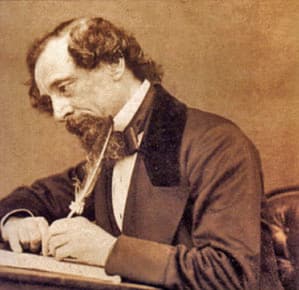
CHARLES DICKENS
Dickens was born on February 7, 1812, the son of a clerk at the Navy Pay Office. His father, John Dickens, continually living beyond his means, was imprisoned for debt in the Marshalsea in 1824. 12-year-old Charles was removed from school and sent to work at a boot-blacking factory, earning six shillings a week to help support the family. This dark experience cast a shadow over the clever, sensitive boy that became a defining experience in his life, he would later write that he wondered "how I could have been so easily cast away at such an age."
This childhood poverty and feelings of abandonment, although unknown to his readers until after his death, would be a heavy influence on Dickens' later views on social reform and the world he would create through his fiction.
Dickens would go on to write 15 major novels and countless short stories and articles before his death on June 9, 1870. He wished to be buried, without fanfare, in a small cemetery in Rochester, but the Nation would not allow it. He was laid to rest in Poet's Corner,Westminster Abbey, the flowers from thousands of mourners overflowing the open grave. Among the more beautiful bouquets were many simple clusters of wildflowers, wrapped in rags.